Port Security A Concern As Funds Shrink

Shortly after the Sept. 11 terrorists attacks, Bridgeport made its summer marine police unit a year-round effort to protect the port, where oil, coal, bananas and pineapples arrived on ships from Colombia, Costa Rica and Indonesia.Police officer Ed Martocchio signed up for the harbor patrol, motivated by 9/11. Today, he remains on alert.“I spend every waking hour and some sleeping hours worrying about them,” Martocchio said of terrorists, dragging his hands down his tanned face while patrolling the harbor by boat one hot August day. “What are they going to do next? Where are they going to do it?”Martocchio, 43, boards tankers with the Coast Guard to check the passports of the international crews, giving him a front seat on the war on terror.“I went from being an ordinary city cop to someone who can potentially have an international impact,’’ he said.
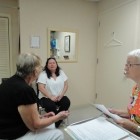
Juana Pecunia, (at left) speaks through her interpreter, Glenda Wagner, as her doctor listens.

Interpreters: Need Grows But No Funding In CT

Quality health care relies on patients and doctors communicating well, but in Connecticut medical interpretation is not covered by public or private insurance. In 2007 the state extended coverage for face-to-face professional interpreters for all Medicaid patients and estimated its cost at $4.7 million yearly, half of which would be reimbursed by the federal government. But the program has never been funded in the state budget, so none of the services promised under the law have ever been delivered.

Prisons Try To Span Learning Gap

Christine Murphy recalls a young man who was barely able to read when he first was imprisoned at the Brooklyn Correctional Institution.“Within six months he had made a three-year gain in reading,” said Murphy, director of special education for the school district that operates 17 schools within the state’s prisons. “On average, our students will gain two grade levels in a year.”Murphy and other educators working in the prisons, where programs serve adults and teenagers as young as 14 who were adjudicated as adults, say this man’s severe educational deficiency is far from unique. Despite having attended public schools for years, many prisoners read, write and perform math tasks at only the most basic of levels. Reading deficiencies are extremely common and many prisoners are virtual non-readers or read at a level more typical of a first- or second-grader. In the 2009-10 school year, there were 9,492 students in Unified School District 1 that operates in the state’s prisons. Of those, about 20 percent have mental health issues and 1,700 received special education services. Most also lack basic social skills such as making eye contact during a conversation and not reacting to frustrations with violence.

‘Model Workplaces’ In CT Not Always Safest

n February 2007, David Gootkin came to the state Capitol in Hartford to testify in favor a bill prompted by his brother Robert’s death the year before at Covanta’s waste-to-energy plant in Wallingford. The bill, which eventually was adopted, requires that operators of solid waste facilities have at least two employees or a camera in the work area when waste is being fed into a hopper.

Health Premiums Double In Decade

Connecticut’s private employers have seen the price of health insurance premiums for workers and their families rise 102 percent since 1999, an analysis by C-HIT shows.