Infant’s Death Leads To Discovery Of Mystery Family Illness By Yale Researchers

For more than 40 years, Erik Drewniak has been plagued by high fevers and chills and never knew why. Whenever he got a 104 or 105-degree fever that would linger for a day or two, he and his family always figured that was just “how he got sick.” He still was able to excel at school, play sports and live a normal life, but the fevers would strike intermittently. It wasn’t until late 2012 into early 2013, following the death of his newborn son, that Drewniak learned what has been causing his fevers. He has an extremely rare gene mutation that Yale School of Medicine researchers uncovered through DNA sequencing. “I’m definitely grateful,” said Drewniak, 45 of Fairfield.


Long ER Stays For Kids In Crisis On The Rise

Just a few years ago, it was rare that children with mental health problems would spend two or more nights in the emergency room at Connecticut Children’s Medical Center. Only 40 children stayed that long in 2010. So far this year, more than 250 children have spent multiple nights in the emergency department (ED) – a number expected to reach 500 by the end of the year. As policy makers work to finalize a statewide children’s behavioral health plan, a report by the hospital, obtained by C-HIT, projects that children with mental health problems will spend a total of 3,085 nights in the ED – more than triple the number in 2010. The average stay is about 15 hours, with some children remaining in the ED for 10 days or more.

Early Pregnancy Blood Test Reducing Need For Amniocentesis

A simple blood test is transforming the world of prenatal screening, offering women a risk-free way to learn about fetal abnormalities early in pregnancy. Already, the new test has drastically reduced the demand for amniocentesis, an invasive procedure that diagnoses chromosomal disorders in mid-pregnancy and occasionally causes miscarriage. The blood test, which became available in late 2011, can analyze DNA to predict Down Syndrome and a few other genetic diseases as early as nine weeks in pregnancy, says Dr. Daniel Gottschall, medical director of Women’s Health Connecticut, a group practice with 80 offices around the state. “It’s almost like science fiction to see how they can do this with such a high level of accuracy,” says Leslie Ciarleglio, a genetics counselor at Hartford Hospital, where the number of amniocentesis procedures plummeted by more than 70 percent in just two years — from 112 in 2011 to 32 in 2013.   “It’s far more accurate than any screening test we’ve had before.”

The test, which experts consider one of the most important clinical tools to emerge so far from the genomics revolution, can alleviate fear and suffering for pregnant women worried about birth defects.   But the medical advance also raises disturbing questions about the future of screening — and whether the quest for the perfect baby could go too far. Currently, most women who get the blood tests are carrying high-risk pregnancies.

Dangers Of Overtreatment Focus Of March 18 Foundation Forum

Why does the U.S. health care system rank in the bottom third of developed nations, even though we spend twice as much as any other country? According to Shannon Brownlee, senior vice president of the Lown Institute and author of the book, “Overtreated: Why Too Much Medicine Is Making Us Sicker and Poorer,” the crux of the problem lies within the doctor-patient relationship. “We have a dysfunctional system in this country that is largely focused on doing more,” Brownlee said. “In our headlong rush to do a lot, fast, we forget about talking to patients  — about what their prospects are, what the treatment options are, what the side effects are . .

Undocumented Immigrants To Strain Safety-Net Hospitals

Undocumented immigrants are expected to make up a larger share of Connecticut’s uninsured population next year, putting new financial pressures on safety-net hospitals that provide emergency care to everyone, state and national health experts predict. The Affordable Care Act (ACA) provides coverage options for legal immigrants, but those in the U.S. illegally cannot apply for Medicaid, even if they are poor, or buy coverage at Access Health CT (the new insurance marketplace), even if they have cash. That means illegal residents without coverage will continue turning to local emergency departments for care at a time when Connecticut hospitals face the loss of millions of dollars in federal and state subsidies to help defray the cost of uncompensated care. “This is a global problem that isn’t going away. This population (of undocumented residents) is not being addressed by any state or federal initiatives.

Most CT Hospitals Face Medicare Penalties For Quality Measures

More than two-thirds of Connecticut hospitals will face Medicare penalties for lagging clinical-care measures in the fiscal year that began Oct. 1, with smaller hospitals including Johnson Memorial, Windham and New Milford losing the highest percentage of reimbursement. The penalties, under a federal program known as Value-Based Purchasing, average .26 percent nationally, with Connecticut’s hospitals losing an average of .23 percent, according to federal data compiled by Kaiser Health News. None of the state’s hospitals will lose the maximum possible penalty, 1.25 percent of funding, federal data shows. Johnson Memorial and Windham are the only two hospitals that will lose more than .5 percent of their Medicare payments – up slightly from the penalties they faced last year.

Long ER Waits: Half Of CT Hospitals Over National Average Of 28 Minutes

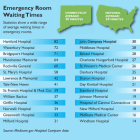
In more than half of Connecticut’s emergency rooms, the waiting time to see a health-care provider exceeds the national average of 28 minutes – a problem that experts say could get worse, as thousands more residents obtain health insurance. The average wait can stretch to an hour or more at Rockville General, Manchester Memorial, Bridgeport, Waterbury and Hartford hospitals, according to a C-HIT review of federal data. The statewide average waiting time is 30 minutes. The longest wait time is at Hartford Hospital, where patients were not seen for 82 minutes, on average; the shortest wait of 14 minutes is at Windham Hospital, the data compiled by the Centers for Medicare & Medicaid Services (CMS) through 2012 show. Officials at Hartford and Bridgeport hospitals claim shorter wait times than the federal data.

Hospitals Show Financial Gains, But Smaller Facilities Struggle

Connecticut’s acute-care hospitals ended the last fiscal year in slightly better financial health than in the prior year, with just five of 30 hospitals reporting losses, according to a new state report. Data filed with the state Office of Health Care Access (OHCA) shows that six hospitals had operating losses in the 2012 fiscal year – the same number as in 2011, but fewer than in 2010. When non-operating gains and losses are included, five hospitals had negative total margins, or deficits – down from eight in 2011. The annual OHCA report paints a positive picture of the overall financial health of hospitals, highlighting that Connecticut’s hospitals had a total gain from operations of about $513 million in the last fiscal year – a substantial increase, of close to 70 percent, over the prior year. Total hospital net assets also increased.

Medical-Legal Partnership Aims To Help At-Risk Children

Three months after a new children’s advocacy office opened at Yale-New Haven Hospital, Alice Rosenthal has conquered bedbugs, kept utilities from being shut off, and helped get adequate school support for a kid with severe medical needs. “We’re off to a fast, great start,” said Rosenthal, the attorney on site for the venture. The office is a partnership between the hospital and the Hartford-based Center for Children’s Advocacy, a nonprofit that advocates for the legal rights of children who suffer from abuse, neglect or lack of access to critical services. The partnership takes a holistic approach to care by tackling not only kids’ medical problems, but the issues at home and school that might be preventing them from getting well. Rosenthal, representing the Center for Children’s Advocacy, works with the hospital staff to identify and resolve those issues.