How Much Is A New Hip? Now You Can Compare Prices

Hospitals in Connecticut charge vastly different amounts of money for the same procedure – sometimes triple the price — according to data released Wednesday by federal Medicare officials. The cost discrepancies are detailed in a report by the federal Centers for Medicare & Medicaid Services, which for the first time is making data available to the public on prices for the 100 most common medical procedures. The report shows what hospitals charge to Medicare, as well as the lower amounts that they collect from the government. In Connecticut, prices for most procedures varied widely among hospitals.  For a cardiac pacemaker implant, for example, Yale-New Haven Hospital’s average bill was $85,902, while Manchester Memorial Hospital billed a low of $22,096. Stamford Hospital billed $25, 493 to treat simple pneumonia, while Charlotte Hungerford Hospital’s average bill was $8,177.

State Hospitals Face 2nd Highest Rate Of Federal Penalties Nationwide

Connecticut fared second-worst in the country in the percentage of hospitals hit with federal penalties for selected quality-of-care measures and in the overall rate of loss of Medicare reimbursements associated with those penalties, new federal data shows. Eighty-six percent of the state’s 30 acute-care hospitals were penalized under Medicare’s Value-Based Purchasing Program, an incentive program created under the Affordable Care Act to reward hospitals on a number of quality measures related to treatment of patients with heart attack, heart failure, pneumonia and certain surgical issues, as well as patient satisfaction. Overall, the state’s hospitals lost .15 percent of their Medicare reimbursement, compared to a .02 percent average loss nationally, the data shows. In addition to the penalties on quality measures, 23 Connecticut hospitals lost Medicare funding because of high rates of readmitting patients within 30 days of a hospital stay. Four faced the maximum loss, a 1 percent reduction in funding: Griffin Hospital in Derby, the Hospital of St.

Surgical Errors Climb, Bed Sores Decline In State’s Hospitals

Reports of wrong-site surgeries increased 62 percent in the past year in Connecticut hospitals, while the number of patient deaths or disabilities resulting from surgery or falls also rose, a new state report shows. At the same time, reports of patients suffering from serious pressure ulcers declined, as a number of hospitals made progress in preventing the painful bed sores. The new Adverse Event Report, compiled by the state Department of Public Health and covering 2011, marks the second year that acute-care hospitals and other medical facilities have been publicly identified by name, as they report errors that caused harm to patients. The five hospitals with the highest rate of adverse events in 2011, calculated per 100,000 inpatient days, were: Charlotte Hungerford Hospital, in Torrington (49.2); Sharon Hospital (35.4); New Milford Hospital (32.9); Stamford Hospital (19.7); and the Hospital of Central Connecticut, in Southington and New Britain (19.3). In terms of the sheer volume of events, Yale-New Haven and its affiliated Hospital of St.

Medication Errors, Confusion Common For Hospital Patients: Yale Study

As a practitioner at Yale-New Haven Hospital, Dr. Leora Horwitz has seen her share of patients who misunderstand medication changes made during their hospital stays. Just recently, one of her female patients, who was switched to a new beta blocker for high blood pressure during an inpatient stay, landed back in the hospital after discharge because she had taken both the new medication and her old beta blocker – a combination that lowered her heart rate and blood pressure to dangerous levels. “Every physician can tell you about these kinds of errors,” Horwitz said. “We do a relatively poor job of educating patients about their medications.”

As a researcher, Horwitz can now quantify those lapses.  A recent study she led looked at 377 patients at Yale-New Haven Hospital, ages 64 and older, who had been admitted with heart failure, acute coronary syndrome or pneumonia, then discharged to home. Of that group, 307 patients – or 81 percent — either experienced a provider error in their discharge medications or had no understanding of at least one intended medication change.

Yale, St. Raphael’s Detail Plans For Merger

The proposed merger of Yale-New Haven Hospital and the Hospital of Saint Raphael solves problems for each of the hospitals: Yale needs at least 140 new patient beds in the next five years, and St. Raphael’s is facing a projected $8 million shortfall in 2013, according to the Certificate of Need application filed with the state this month.

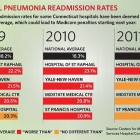
Hospital Pneumonia Readmission Rates

Hospitals To Face Penalties For High Readmissions

Patients treated for pneumonia at four Connecticut hospitals have ended up readmitted to the hospital within 30 days at rates significantly higher than the national average—a lapse that the federal government considers costly and potentially harmful, and that could lead to Medicare penalties beginning in 2012.