Families Brace For Changes In Autism Diagnosis

Proposed changes to the official autism diagnosis are raising concerns among advocates and families, with many fearing the new criteria will lead to a loss of services and a sense of identity for some high-functioning individuals with special needs. “There’s no question some people (on the autism spectrum) will lose services,” said Dr.  Fred Volkmar, an internationally renowned expert on autism and director of the Yale Child Study Center.  Volkmar was the lead author of a study that found that only 45 percent of those currently diagnosed with higher functioning forms of autism would meet the new criteria. Sarah Reed, director of advocacy and family services for the Connecticut Autism Spectrum Resource Center in Wallingford, predicted “chaos in the coming months. Families are confused and concerned that their loved ones with autism will not qualify for education and support services under the new criteria.” At issue are proposed criteria for autism spectrum disorders (ASD) in the American Psychiatric Association’s Diagnostic and Statistical Manual fifth edition (DSM-5).

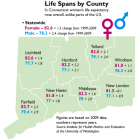
Life spans by counties in Connecticut

Women’s Longevity Falling in Some Parts of U.S., Stress May Be Factor

It’s one of the most disturbing trends in American public health: women’s life spans are shrinking in many parts of the U.S., and no one knows why. Women’s longevity took an unprecedented nosedive during the past decade, researchers recently discovered, with their life expectancy tumbling or stagnating in one of every five counties in the country. In Connecticut, where women’s life expectancy exceeds the national average, New London County saw a drop in longevity, while Fairfield and Hartford counties saw significant jumps. The last time life expectancy fell for a large number of American women was in 1918, due to Spanish influenza. While many scientists believe that smoking and obesity are driving the downward spiral, a growing chorus of experts contends that chronic stress may be a key culprit, too – especially the stress of juggling work and family.

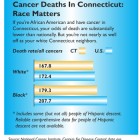
Cancer death rates

Cancer Deaths: Gap Persists Among Blacks, Whites

When Ulysses B. Hammond was diagnosed with prostate cancer, his first thought was that he could wait to deal with it. After all, the doctor said it would spread slowly. That reaction is typical for men – especially African Americans like Hammond — and it plays a role in explaining why they have the highest cancer death rate in the United States and in Connecticut. “It’s not deemed very macho to actually admit or discuss physical frailties,” said Hammond, chair of the board at Lawrence & Memorial Hospital in New London. The death rate for African American men and women nationally – 207.7 per 100,000 people – is more than 20 percent higher than the rate for whites, according to 2009 data, the latest from the National Cancer Institute.

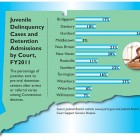
Frequency Of Juveniles Detained Varies Widely

Juveniles in the Hartford judicial district who break the law are far more likely to be locked in a pre-trial detention center following arrests or referrals than juveniles from the state’s other districts, an analysis of data from the judicial department shows. More than a third, or 34 percent, of new delinquency cases in Hartford juvenile court ended up in secure detention, compared to 17 percent in Bridgeport and 20 percent in New Haven, according to fiscal year 2011 data released by the judicial branch. In Middletown, Waterford and Willimantic, fewer than 10 percent of juveniles arrested were sent to detention.

Connecticut Hospitals Don’t Make ‘Top Performer’ List

Connecticut is the only New England state—and one of just three nationally—to have no hospitals designated as “Top Performers” by The Joint Commission, which issued an annual report gauging the performance of more than 3,300 accredited hospitals on 45 accountability measures linked to positive patient outcomes.