State’s Early Childhood Director Wants Better Oversight

The director of the state’s Office of Early Childhood said Thursday she supports increasing the frequency of health and safety inspections of child care facilities, in the wake of a C-HIT story detailing lapses in oversight. “We’re definitely looking into adding inspectors and increasing the inspection frequency” to once a year, said Myra Jones-Taylor, who took the helm of the new office in July. “We’re very much focused on the opportunities we have to improve oversight.”

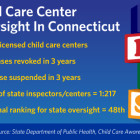
Jones-Taylor’s comments follow a December story by C-HIT that detailed lapses in oversight of the state’s child care centers and family day care homes. A national report by Child Care Aware of America ranks Connecticut 48th in oversight of child care centers, with the third highest caseload per inspector in the country. Connecticut inspects centers once every two years — far less frequently than the Child Care Aware recommendation of quarterly inspections – and rarely revokes or suspends providers’ licenses after violations are cited, the C-HIT review found.

State’s Child Care Oversight: Minimal Monitoring, Lax Enforcement

On its website, the Tumble Bugs Day School in Norwalk boasts a “highly experienced, nurturing” staff who serve infants and toddlers in a “stimulating setting.”

But a review of state Department of Public Health records shows the child care center has had numerous complaints and citations in recent years for lapses in supervision that have injured and traumatized young children. In 2010, the center failed to notify parents when a balancing board fell on a toddler. The same year, DPH cited the center for failing to take action against a staff member who restrained a toddler on a cot by “holding down his head and body” and then falsely reported that a scratch on the boy’s face was an accident. Then, in 2011, two children came forward to report that a preschool teacher had sexually abused them during naptime – an allegation that led to the April 2012 arrest of a 44-year-old Harold Meyers, who worked at the center in 2008 and 2009. DPH investigated the case last year, but determined that the center had made oversight changes and that no further action was needed.

State’s Juvenile Incarceration Rate Plummets: Report

Connecticut is one of nine states recognized in a new national report for significantly reducing youth incarceration rates since 2001 – a drop attributed to new policies and expanded community alternatives to detention. The report by the National Juvenile Justice Network (NJJN) and the Texas Public Policy Foundation’s Center for Effective Justice found that Connecticut had 252 youths confined in 2011 – a drop of 60 percent from 2001 and one of the highest reduction rates in the country. Nationally, youth confinement declined by 41 percent since 2000, when a record-setting 108,802 youths were held in detention? centers awaiting trial or confined by the courts in juvenile facilities. “States have made strides in changing their policies so that youth are held accountable in age-appropriate ways, but there is more work to be done,” said Sarah Bryer, director of the NJJN.

Undocumented Immigrants To Strain Safety-Net Hospitals

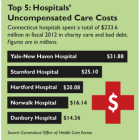
Undocumented immigrants are expected to make up a larger share of Connecticut’s uninsured population next year, putting new financial pressures on safety-net hospitals that provide emergency care to everyone, state and national health experts predict. The Affordable Care Act (ACA) provides coverage options for legal immigrants, but those in the U.S. illegally cannot apply for Medicaid, even if they are poor, or buy coverage at Access Health CT (the new insurance marketplace), even if they have cash. That means illegal residents without coverage will continue turning to local emergency departments for care at a time when Connecticut hospitals face the loss of millions of dollars in federal and state subsidies to help defray the cost of uncompensated care. “This is a global problem that isn’t going away. This population (of undocumented residents) is not being addressed by any state or federal initiatives.

Most CT Hospitals Face Medicare Penalties For Quality Measures

More than two-thirds of Connecticut hospitals will face Medicare penalties for lagging clinical-care measures in the fiscal year that began Oct. 1, with smaller hospitals including Johnson Memorial, Windham and New Milford losing the highest percentage of reimbursement. The penalties, under a federal program known as Value-Based Purchasing, average .26 percent nationally, with Connecticut’s hospitals losing an average of .23 percent, according to federal data compiled by Kaiser Health News. None of the state’s hospitals will lose the maximum possible penalty, 1.25 percent of funding, federal data shows. Johnson Memorial and Windham are the only two hospitals that will lose more than .5 percent of their Medicare payments – up slightly from the penalties they faced last year.

Middle-Age “Senior Moments’’ Just Part Of Aging

Everyone occasionally struggles to remember a name, blanks out on an appointment or forgets why they walked into the other room. But somewhere around age 40, those “senior moments” start to take on a new seriousness. They suddenly seem like scary signs of aging, perhaps harbingers of major memory loss to come. “A few years ago, these complaints were just dismissed,” says Dr. Anne Louise Oaklander, a neurologist at Massachusetts General Hospital in Boston. Now, researchers have become interested in mid-life memory, both to understand their patients’ complaints, and because of the recognition that the seeds of dementia are laid around this time of life.

Long ER Waits: Half Of CT Hospitals Over National Average Of 28 Minutes

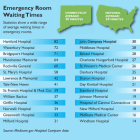
In more than half of Connecticut’s emergency rooms, the waiting time to see a health-care provider exceeds the national average of 28 minutes – a problem that experts say could get worse, as thousands more residents obtain health insurance. The average wait can stretch to an hour or more at Rockville General, Manchester Memorial, Bridgeport, Waterbury and Hartford hospitals, according to a C-HIT review of federal data. The statewide average waiting time is 30 minutes. The longest wait time is at Hartford Hospital, where patients were not seen for 82 minutes, on average; the shortest wait of 14 minutes is at Windham Hospital, the data compiled by the Centers for Medicare & Medicaid Services (CMS) through 2012 show. Officials at Hartford and Bridgeport hospitals claim shorter wait times than the federal data.

CT Joins $1.2 Billion Settlement With Johnson & Johnson, Janssen

Connecticut will receive more than $10 million in one of the largest pharmaceutical fraud settlements in history, as Johnson & Johnson and its subsidiary, Janssen Pharmaceuticals, Inc., resolve allegations of unlawfully marketing two antipsychotic drugs, including Risperdal, heavily used among nursing-home patients. Johnson & Johnson has agreed to pay a total of $2.2 billion to states and the federal government to end civil and criminal investigations into off-label marketing of Risperdal and Invega, both antipsychotics, as well as the heart drug Natrecor, for uses not approved by the U.S. Food and Drug Administration. The company allegedly paid kickbacks to physicians and pharmacists to promote the drugs for unapproved uses. In documents filed Monday, federal officials said that Johnson & Johnson, through Janssen, marketed Risperdal to doctors for use in elderly dementia patients, even though the drug was approved only for schizophrenia. Connecticut’s rate of antipsychotic use in nursing homes remains in the top 20 nationally, but has dropped in recent years, a recent C-HIT analysis found.