State Second-Lowest Nationally In Reporting Drunk Driving Data

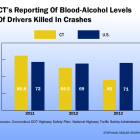
Connecticut had one of the highest rates in the nation of motor vehicle fatalities in which drivers were alcohol impaired in 2013, the most recent year for which data is available – 41 percent, compared to the national average of 31 percent, according to federal estimates. But the state also had one of the lowest rates nationally of reporting drunk-driving data in fatal accidents – a lapse that hampers efforts to gauge the impaired-driving problem and to develop and evaluate programs to address it, experts say. Connecticut reported blood-alcohol concentration (BAC) results for just 45 percent of fatally injured drivers — far lower than the national average of 71 percent, according to data collected by the National Highway Traffic Safety Administration (NHTSA). Only Mississippi reported a lower rate of such testing. Thirty-four states reported testing rates of more than 70 percent.


Fewer Errors Reported By Hospitals, But Concerns Remain

Connecticut hospitals reported fewer numbers of patients killed or seriously injured by falls or perforations during surgery or suffering from severe pressure ulcers in 2014 than in 2013, but the incidence of such “adverse events” still remains higher than in 2012, a new state report shows. The report by the Department of Public Health (DPH) shows that the total number of hospital adverse events, or errors, dropped by 12 percent — from 534 in 2013, to 471 last year. Deaths or serious injuries from falls declined from 90 to 78; perforations during surgical procedures fell from 79 to 70; and life-threatening medication errors fell from six to one. The number of patients with serious pressure ulcers dropped from 277 to 245. Rates of all four of those incidents had climbed in 2013, in part because of an expansion of required reporting on pressure sores to include “unstageable” ulcers.

Are OB-GYN Well Visits Short-Changing Women?

During their childbearing years, many women view their obstetrician-gynecologists as primary care physicians, seeing them for preventive health care as well as for reproductive-related issues. Several studies, including one published in 2014 in the Journal of the American Medical Association (JAMA), indicate that women may be shortchanging themselves by consulting only an OB-GYN for preventive health care visits. The national study of 63 million preventive health visits by non-pregnant women found that those “of reproductive age who see OB-GYNs only for preventive care may not be receiving the full spectrum of recommended screening and counseling.”

A number of Connecticut OB-GYNs and other women’s health care specialists said, however, that they are aware of the unique role they play, and that they make a point of addressing patients’ broader needs, especially when meeting a new patient. These needs vary, of course, depending on a woman’s lifestyle, risk factors and age. “If you’re young, in your 20s, don’t smoke and are healthy, you’re very low risk,” said Dr. Susan Richman, a Branford OB-GYN.   “What [those patients may] have is very treatable, and I’m comfortable treating them.”

The JAMA study of “well-woman” visits from 2007 to 2010 showed that while OB-GYNs generally screened for cervical and breast cancers, chlamydia and osteoporosis, general practitioners more often screened for colorectal cancer, cholesterol counts and diabetes.

Derby Nurse Pressured By Drug Company To Boost Sales

A Derby nurse who admitted taking kickbacks from a drug company that makes the powerful painkiller Subsys was pressured by sales representatives to increase her prescribing “so that the Subsys numbers would also increase,” according to court documents. In a hearing transcript recently made public, federal prosecutors charged that Heather Alfonso “continued to increase her prescribing of Subsys and to find more patients for whom she could prescribe the drugs” in exchange for a series of $1,000 kickbacks, totaling $83,000, from the company, Insys Therapeutics. Although the potent narcotic is approved only for cancer patients, some of the patients given Subsys by Alfonso “did not have a cancer diagnosis,” which would have meant that Medicare and private insurers would have refused to pay claims, federal prosecutors said. But “prior authorizations” submitted on behalf of patients falsely represented that they had cancer, misleading insurers into paying for the drug. It is not clear in the testimony who was involved in submitting the false authorizations to Medicare and insurers.

Blumenthal, Grassley Call For Expanded Drug Company Reporting

US Sen. Richard Blumenthal (D-Conn.) and U.S. Sen. Chuck Grassley (R-Iowa) have introduced legislation that would require drug companies and medical device manufacturers to start reporting their payments to nurse practitioners and physician assistants, as they do for physicians. “Requiring companies to disclose gifts and payments made to other health care providers – not just doctors – is absolutely essential,” Blumenthal said in a statement Tuesday. “The Provider Patient Sunshine Act will rein in dishonorable behavior by increasing transparency and accountability across the entire healthcare industry.”

Grassley added: “It makes sense to apply the sunshine (provisions) to anyone who prescribes medicine.”

The proposed Provider Payment Sunshine Act, would require drug companies and device makers to publicly disclose payments to nurse practitioners and physician assistants for promotional talks, consulting and other services. The companies already report such payments to physicians in a national Open Payments database, under prior legislation co-authored by Grassley. The payments to nurse practitioners and physician assistants would be added to that database. Nurse practitioners and physician assistants write a significant number of prescriptions in the federal Medicare program, data show.

Yale: Cancer-Screening Guidelines May Play Role In Decline In Screening Rates

Declines in several key cancer-screening procedures among the elderly can be linked to shifts in screening guidelines issued by major public health organizations, according to recently released findings by Yale researchers. James Yu, associate professor of therapeutic radiology at the Yale School of Medicine, and Sean Maroongroge, a third-year medical student, gleaned data from Medicare billing records from 2000 to 2012, analyzing more than 230 million screenings for prostate, breast, and colorectal cancers. Yu, a member of the Yale COPPER Center (Cancer Outcomes, Public Policy, and Effectiveness Research Center), and Maroongroge, also tracked evidence-based screening guidelines issued by five prominent organizations: the U.S. Preventive Services Task Force (USPSTF), the American Cancer Society (ACS), the American College of Obstetricians and Gynecologists (ACOG), the American College of Gastroenterology (ACG), and the American Urological Association (AUA). They found that the rates for mammography, which is the primary means of screening for breast cancer, declined 7.4 percent overall during the period studied; prostate screening rates rose 16 percent during the first seven years studied then declined to 7 percent less than the 2000 rate by 2012. Colorectal cancer screening rates also dropped overall.

Reporting Of Pharma Payments To APRNs To Start In 2017

A state initiative that would have required drug companies and device manufacturers to start reporting their payments to advance practice registered nurses (APRNs) this year has been delayed to 2017. The original APRN legislation, passed in 2014, called for quarterly reporting beginning in July 2015. That law was amended this spring to push back the start date and require only annual reporting, after urging from the pharmaceutical industry, state officials said. The delay comes as an APRN at a pain clinic in Derby, Heather Alfonso, awaits sentencing on charges that she received kickbacks from the drug company Insys Therapeutics in exchange for prescribing a potent painkiller intended for cancer patients. The payments to Alfonso for promoting the drug were not reported publicly under federal rules because APRNs are not included in the Physician Payment Sunshine Act, which requires public reporting of drug company payments only to physicians and teaching hospitals.

Tainted Dietary Supplements Frequently Hit The Market

Every week for the past 7½ years, the U.S. Food and Drug Administration has identified an average of two dietary supplements being sold to consumers that were “tainted” and “potentially hazardous,” a C-HIT analysis of data reveals. The supplements contained prescription drug ingredients, controlled substances or untested pharmaceutical ingredients, which is prohibited by federal law and “can pose considerable dangers to consumers,” including stroke, liver damage, kidney failure and death, according to the FDA. C-HIT’s analysis of FDA data reveals 615 dietary supplements that were identified as tainted since Jan. 1, 2008. In the first half of this year alone, 59 tainted dietary supplements were posted on the FDA’s site.