CT Fails Consumers Looking For Health Care Costs

Connecticut was among 29 states nationwide to earn an “F” from health advocates for lacking consumer-friendly laws that help residents compare actual prices for health care procedures and services. “There is no public resource in Connecticut that makes (comparison) pricing information available to consumers. That means there’s no consumer protection against egregious pricing behaviors by providers,” said Francois de Brantes, executive director of the Health Care Incentive Improvement Institute in Newtown, which partnered with Catalyst for Payment Reform to publish the “Report Card on State Price Transparency Laws.”

The Report Card’s scores reflected a state’s overall legislative effort toward health care price transparency, with states that post price information on a public website receiving more points than those that release a report or provide data to consumers only upon request. The organizations that developed the report card are nonprofits that support payment reforms to increase the quality and value of health care. Ellen Andrews, executive director of the Connecticut Health Policy Project, said, “The score is totally warranted.

Connecticut Pilots Patient Safety Program For Nursing Homes

In the 1970s, after investigators reported that more than 70 percent of air crashes involved human error, the aviation community worked with psychologists to develop a training protocol to improve teamwork, decision-making and safety. Since then, that core training has been adapted for use in other professions, including the military, firefighting and medicine. Now, health professionals in Connecticut have taken those basic lessons and drafted a training protocol for yet another high-risk setting: Nursing homes. The authors of the program, called TeamSTEPPS for Long-Term Care, say the simple training can save lives and money. They plan to pilot the program in Connecticut in the fall and promote it nationally.

Top Execs At “Big Five’’ Health Insurers Each Pull In Millions

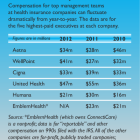
Health care reform, new Wall Street regulations and outrage over large pay packages are likely to put pressure on compensation for health insurance executives. But it doesn’t seem to have happened yet. The highest-paid executive at each of the “Big Five’’ health insurers – UnitedHealth Group, Aetna Inc., WellPoint Inc., Humana Inc. and Cigna Corp. – made more than $8 million in 2012, according to filings this spring with the Securities and Exchange Commission. The CEO of EmblemHealth Inc., a nonprofit that owns ConnectiCare, also had total compensation at that level in 2011, the last year for which information is available.

Mental Health Team Hits The Road To Help Youth In Crisis

Ten-year-old Joey Smith shared a celebratory high-five with Heather Kunkel, a mental health professional who was visiting the boy’s Thomaston home. “Things are great, spectacular even,” he said, as the two chatted at the kitchen table. It’s a dramatic turnaround for Joey who met Kunkel when she was summoned to Thomaston Center School because he had threatened to harm himself. Now Joey, who has autism, is back at school with a modified curriculum to suit his individual needs and his parents have access to an educational advocate and community resources. The Smiths are among the thousands of Connecticut families turning to the Emergency Mobile Psychiatric Services (EMPS) — a crisis intervention program that includes a network of 150 mental health professionals who assist children experiencing a behavioral or mental health crisis at home, school or in the community.

Connecticut Lags In Kids’ Mental Health Screening; Reforms Considered

Selenia Velez remembers the near-daily phone calls from the pre-school, alerting her that her 2-year-old son had acted out aggressively and needed to be picked up immediately. The calls went on for months, as Velez, 27, of Hartford, and her husband bounced between the pre-school and their son’s pediatrician, who recommended that they take him to a psychiatrist for an evaluation. But the psychiatrist was booked and held them at bay, as Velez watched her son’s behavior deteriorate. “We just felt hopeless,” the mother of four recalls of her oldest son, now 7. “It was one of the most heartbreaking things you can go through as a mother.

State Raises Financial Penalties For Nursing Homes

Last summer, the state Department of Public Health fined a Danielson nursing home $580 after a resident whose feet were not properly secured to a wheelchair suffered a hip fracture. This January, a Waterbury nursing home was fined double that amount — $1,160 — after an incident in which a resident sustained a cut on the forehead during a fall, while being transferred to a toilet without proper precautions. Similarly, the Lutheran Home of Southbury paid a $615 state fine last spring, after a resident who was supposed to be served a “soft diet” was instead served a meal of ham and carrots and choked to death. Then more recently, in February, the state fined the Paradigm Healthcare Center of Norwalk double that amount — $1,230 — in connection with the death of a resident who choked on food that had been left on a tray at a nursing station. Why the differences in penalties?

Dempsey Hospital Makes Progress Reducing Double CT Scans

UConn’s John Dempsey Hospital has drastically reduced the frequency of “combination” CT scans of patients’ chests and abdomens, as federal regulators have clamped down on the practice, which carries a risk of excess radiation. New data provided by Dr. Douglas Fellows, chair of radiology at the UConn Health Center, shows that the hospital has reduced the rate of double scans of the chest to below 1 percent, and the rate of combination abdominal scans to 23 percent for Medicare patients, the population that federal regulators track. A 2011 story by C-HIT  disclosed that Dempsey’s double-scan rate was the highest in the state and far exceeded the national average, with 48 percent of all patients who received chest scans subjected to combination scans—nearly 10 times the national average—and more than 72 percent who received abdominal scans getting double procedures. That data was from 2008. Fellows said the hospital has made a concerted effort in the last two years to crack down on double scans, by educating emergency department personnel, physicians in other parts of the hospital, and community doctors who order the scans.