Nurses’ Drug Abuse Top Cause Of Disciplining, But Once Sober, Some Nurses Get Relicensed

Out of work and addicted to the anti-anxiety medication Klonopin, Heather Delaney, a licensed practical nurse from Stratford, checked herself into Bridgeport Hospital in 2011 when she could no longer handle withdrawal without medical help. After a brief hospitalization following a suicide attempt the previous fall, Delaney spent two horrific months on her own in the throes of withdrawal. The corners of her eyes felt “chapped,” and “it felt like somebody had wrapped me up in a scratchy blanket of needles,” said Delaney, who had given up her nursing license after being caught altering her Klonopin prescription. Sara Kaiser, an LPN living in Manchester, stole morphine from the nursing homes where she worked and was addicted to heroin from age 18 to 24. She spent time homeless and in prison, ultimately going through 14 rehab programs before getting sober in 2010.

Tribute To Lisa Chedekel, An Extraordinary Journalist

Lisa Chedekel was a treasure who found me. We launched the Conn. Health I-Team in 2010 after working together for over 30 years, first at the New Haven Register and later at the Hartford Courant. Today she leaves a rich and powerful legacy that touched so many of us in Connecticut. That legacy includes all the aspects of what a journalist is.

Connecticut Sees Uptick In Stroke Deaths

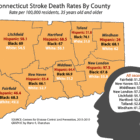
While the prevalence of strokes in Connecticut has essentially remained the same in recent years, progress in slowing the number of deaths from stroke has declined in the state, a development the Centers for Disease Control and Prevention (CDC) calls “disturbing.”

The spike reverses a national decades-long trend that brought stroke death rates down. From 1999 to 2014, deaths from strokes were on the decline in the state and nationally. But a recent CDC report found that Connecticut was among 39 states in which the decline in stroke deaths has slowed or the number of stroke deaths has started to increase. From 2012 to 2015, the number of stroke deaths in Connecticut increased 9.5 percent, from 1,263 to 1,384. Stroke deaths were highest in the northeast and northwest regions of the state, CDC data show.

Report: 27 Facilities Using Hazardous Chemicals Pose Risk To Thousands Of Low-Income Neighbors

There are 27 facilities in Connecticut that use such large quantities of hazardous chemicals that they are required to submit disaster response plans to the U.S. Environmental Protection Agency. About 170,000 people—roughly 5 percent of the state’s population—live within a mile of these facilities, risking exposure to a leak, explosion or adverse health effects. Low-income people and children of color under the age of 12 are more likely than their white counterparts to live in these “fenceline” communities, according to a report by the Center for Effective Government. In its report “Living in the Shadow of Danger: Poverty, Race and Unequal Chemical Facility Hazards,” the center examined more than 12,500 facilities in 50 states, grading states based on the “disparities faced” by people living adjacent to or near these facilities. The center reported that children of color under age 12 living in the state were 2.2 times more likely than white children to live within a mile of one of these facilities. In many instances, residents are unaware of the dangers just blocks from their homes, the report said.

As State Steps Up Efforts To End Child Sex Trade, Public’s Ignorance Is Still An Impediment

In the weeks before Bridgeport police rescued the teenager from the motel, she’d been forced by her pimp to have two tattoos identifying her as belonging to him inked on her face and neck.  She’d been given morphine and crack. And she’d been sold on the internet, she told police, “to over 50 or 60 dirty men.”

The girl, who was 17 when she was pulled from “the life” on Aug. 26, 2015, is one of more than 650 children and adolescents referred to the state Department of Children and Families (DCF) as victims of sex trafficking since 2008. Nearly one-third of those were referred last year alone, a result of the state’s ramping up its anti-exploitation efforts.

Conversation With Your Doc May Be The Best—And Most Elusive—Medicine

When doctors and patients communicate well, research shows that patients are more likely to follow treatments, recover more quickly and are less likely to be the victims of medical errors. But with an average office visit of just 18 minutes and an increasingly complex variety of diagnostic and therapeutic options, good communication may be modern medicine’s final frontier. In this podcast, sponsored by ConnectiCare, Dr. Juan Estrada, medical director of Sanitas Medical Centers and Lisa Freeman, director of  the Conn. Center for Patient Safety, provide tips on how to communicate with your doctor. A recent patient survey by ConnectiCare found that patients generally rated communication with their doctors highly, but there were concerning gaps.

Less Access To Health Services, Programs In Rural Areas Take Toll

Connecticut’s rural residents die at higher rates than their city and suburban counterparts and a large percentage of those deaths may be preventable if better public health programs or better access to health care services were available, according to the latest data from the National Center for Health Statistics (NCHS). Doctor shortages and long commutes make it harder for rural residents to get­­ health care. And some officials worry that changes in hospital ownership and the Affordable Care Act could amplify existing problems.

“We have excellent medical care as a general rule in the state,” state Rep. Susan Johnson, D-Windham, said. But rural and other high poverty areas, where many residents are on Medicaid rather than private health insurance, remain vulnerable to hospital service reductions and changes in eligibility for health care coverage, she said. “My battle is to make sure the basic hospital services, like critical care units, are maintained in the small rural hospitals,” Johnson said.

It’s Time To Fund Gun Violence Research

After a white terrorist (can we just start calling these people what they are?) shot and killed at least 59 people and injured another 527 at an outdoor country music contest in Las Vegas this week, Nelba Márquez-Greene took to Twitter:

“Guess what folks? Gun violence and grief hurt in EVERY zip code. In every color. Grieving mothers need your help.”

Who can forget Márquez-Greene and her family? After her 6-year-old daughter Ana was shot and killed in the 2012 Newtown school massacre, Márquez-Greene and husband Jimmy Greene, the award-winning musician, have continually reminded this country that we can do more than offer thoughts-and-prayers over gun violence.

Medication Helps People Stay Off Opioids

Combining medication with other forms of therapy can help people with opioid addition avoid relapse by calming cravings and managing the symptoms of withdrawal. Less than half of the privately drug addiction programs nationally offer medication-assisted treatment (MAT); and even in those programs, only one-third of patients receive MAT, according to the National Institute of Drug Abuse. In Connecticut, there are about 40 Medicaid providers that prescribe medication for treatment. In our podcast, sponsored by Wheeler Clinic, Dr. Robert Grillo discusses medication-assisted treatment for opioid addiction. Increasing access to MAT is important given the extreme danger associated with relapse, says Dr. Robert Grillo, medical director for psychiatry at Wheeler Clinic.