Port Security A Concern As Funds Shrink

Shortly after the Sept. 11 terrorists attacks, Bridgeport made its summer marine police unit a year-round effort to protect the port, where oil, coal, bananas and pineapples arrived on ships from Colombia, Costa Rica and Indonesia.Police officer Ed Martocchio signed up for the harbor patrol, motivated by 9/11. Today, he remains on alert.“I spend every waking hour and some sleeping hours worrying about them,” Martocchio said of terrorists, dragging his hands down his tanned face while patrolling the harbor by boat one hot August day. “What are they going to do next? Where are they going to do it?”Martocchio, 43, boards tankers with the Coast Guard to check the passports of the international crews, giving him a front seat on the war on terror.“I went from being an ordinary city cop to someone who can potentially have an international impact,’’ he said.

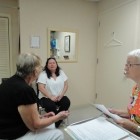
Juana Pecunia, (at left) speaks through her interpreter, Glenda Wagner, as her doctor listens.

Interpreters: Need Grows But No Funding In CT

Quality health care relies on patients and doctors communicating well, but in Connecticut medical interpretation is not covered by public or private insurance. In 2007 the state extended coverage for face-to-face professional interpreters for all Medicaid patients and estimated its cost at $4.7 million yearly, half of which would be reimbursed by the federal government. But the program has never been funded in the state budget, so none of the services promised under the law have ever been delivered.

Prisons Try To Span Learning Gap

Christine Murphy recalls a young man who was barely able to read when he first was imprisoned at the Brooklyn Correctional Institution.“Within six months he had made a three-year gain in reading,” said Murphy, director of special education for the school district that operates 17 schools within the state’s prisons. “On average, our students will gain two grade levels in a year.”Murphy and other educators working in the prisons, where programs serve adults and teenagers as young as 14 who were adjudicated as adults, say this man’s severe educational deficiency is far from unique. Despite having attended public schools for years, many prisoners read, write and perform math tasks at only the most basic of levels. Reading deficiencies are extremely common and many prisoners are virtual non-readers or read at a level more typical of a first- or second-grader. In the 2009-10 school year, there were 9,492 students in Unified School District 1 that operates in the state’s prisons. Of those, about 20 percent have mental health issues and 1,700 received special education services. Most also lack basic social skills such as making eye contact during a conversation and not reacting to frustrations with violence.

‘Model Workplaces’ In CT Not Always Safest

n February 2007, David Gootkin came to the state Capitol in Hartford to testify in favor a bill prompted by his brother Robert’s death the year before at Covanta’s waste-to-energy plant in Wallingford. The bill, which eventually was adopted, requires that operators of solid waste facilities have at least two employees or a camera in the work area when waste is being fed into a hopper.

Health Premiums Double In Decade

Connecticut’s private employers have seen the price of health insurance premiums for workers and their families rise 102 percent since 1999, an analysis by C-HIT shows.

Tricare: Can U.S. Keep Health Promise To GIs?

As communities gather this Memorial Day to honor those who have served their country, some Connecticut veterans and their families are wondering if the nation will be able to honor its promise to provide a lifetime of low-cost, high-quality health care.For retired chief petty officer Chad Colter of Norwich, plans to increase premiums for the Tricare health care system are unconscionable. “When I joined the Navy, the pay was so stinking low that one of the incentives for staying in the military was the promise of free medical care for life,” said the 22-year veteran. “Now that promise is gone.”Traci Miller of New London is willing to pay more for Tricare because the cost is far below private insurance. She’s more concerned about having access to physicians in a timely manner.  “It’s hard to find a doctor that accepts Tricare especially when you need to see a specialist,” said Miller, whose husband retired from the Navy after 20 years.Colter and Miller are among the 50,992 Connecticut members of the armed forces, active National Guard and Reserve, retired military and their families who use Tricare – the military’s main health care program. The program now faces a number of challenges, including: possible higher annual premiums in 2012 and a growing list of physicians reluctant to accept Tricare because of inadequate reimbursement rates. In addition, a critical shortage of physicians in Connecticut makes it difficult for Tricare beneficiaries to access medical care, especially in rural areas. Among the toughest specialists to find in the state are those with expertise in traumatic brain injury and post-traumatic stress—two of the signature injuries of the current wars.

Sex Offender Doc Allowed To Resume Practice

In a controversial move, state officials are allowing a Greenwich physician who is registered as a sex offender to resume his medical practice in Connecticut.In a recent decision, the Connecticut Medical Examining Board, an arm of the Department of Public Health, voted to allow Clifford Berken of Stamford to resume practicing medicine in the state, under certain conditions.  Berken is a registered sex offender in Connecticut and New York, following his arrest and sentencing in New York State on a first-degree charge of attempting to disseminate indecent material to a minor.The medical board, in allowing Berken to resume practicing, placed his license on probation for five years, required him to be overseen by a psychiatrist or psychologist, and barred him from treating patients under the age of 18. The board’s order also requires that Berken have another employee present during “any examination or treatment of a patient,” the records say.