State Fines Four Nursing Homes

The state Department of Public Health (DPH) has fined four nursing homes for various violations, most of which resulted in injuries to residents. Groton Regency Center was fined $2,260 for two incidents that happened in September. On Sept. 12, two staff members reported that a nurse’s aide was seen swearing and pointing a finger at a resident, according to the department’s citation. The resident, who had severe cognitive impairments and suffered from vascular dementia and anxiety, seemed upset and scared at the time, according to the citation, but later could not recall the incident.
TB Cases Rise In Connecticut, Nationally First Increase In 23 Years

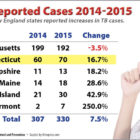
Reported cases of tuberculosis jumped 17 percent in Connecticut from 2014 to 2015, mirroring a national and global trend and prompting federal officials to ask primary care providers to be on the alert for at-risk patients. The state Department of Public Health (DPH) said 70 people, in 29 towns, were reported with active TB, the contagious form of the disease, in 2015, compared with 60 the year before. About 80 percent of Connecticut patients were foreign-born, many from Asian countries. Nationally, TB cases totaled 9,563 last year, an increase of 157 over 2014. It was the first jump in cases after more than two decades of annual declines, the U.S. Centers for Disease Control and Prevention (CDC) reported.

Medical Errors Decline 3 Percent In 2015

Connecticut hospitals reported increases in patient deaths or serious injuries due to falls and medication errors in 2015 compared to 2014, but an overall drop in “adverse events,” according to a new state report. The report, by the Department of Public Health (DPH), shows that the total number of medical errors dipped by 3 percent – from 472 in 2014, to 456 in 2015. There were 90 instances when patients died or were seriously injured in falls, up from 78 in 2014. Seven falls that resulted in injury or death were reported at Yale New Haven Hospital, St. Vincent’s Medical Center and UConn’s John Dempsey Hospital.

State Orders Rocky Hill Nursing Home To Hire Consultant

State health officials have fined the operator of a Rocky Hill nursing home $5,000 and ordered it to hire an independent nursing consultant after finding dozens of violations, most of which involved the care of residents. Under the order, Apple Rehabilitation of Rocky Hill must hire an independent consultant who is a registered nurse. The consultant must be at the facility 32 hours per week and be on-site at various times during all three shifts. The consultant, who must be pre-approved by the state Department of Public Health (DPH), will work for at least six months to ensure “the safety, welfare and well-being of the residents” and to make sure the facility is obeying laws, the consent order said. The consultant is responsible for assessing, monitoring and evaluating direct resident care “with particular emphasis and focus on the delivery of nursing services,” according to the consent order.

Nursing Board Recommends Disciplining Nurse Following Baby’s Death

The state Board of Examiners for Nursing has recommended disciplining an East Hartford nurse for her actions when a 13-month-old girl she was caring for in Manchester stopped breathing and died in 2014. A June 14 investigative report concluded that licensed practical nurse Shirley A. Powell failed to provide rescue breathing and CPR when the girl’s tracheotomy tube became dislodged. The report, by Helen M. Centeno, a nurse consultant for the state Department of Public Health, also found that Powell failed to safeguard the girl by not having a direct view of her in the playpen in the child’s home on the day of the death, Aug. 15, 2014. Manchester police concluded that Powell left the girl out of her line of sight for 3 to 15 minutes and during that time, the tube became dislodged, the report said.

Rest Home Ordered To Hire Consultant After Reports Of Residents Using Marijuana, Alcohol

The state has ordered a Litchfield rest home to hire an independent consultant after finding various violations, including alcohol use and suspected marijuana use among residents. In a consent order signed Sept. 12, the state Department of Public Health (DPH) said Fernwood Rest Home Inc. has to hire an independent contractor, pre-approved by the department, within two weeks of the order’s signing. The contractor must be a licensed nursing home administrator and will work to ensure resident safety and legal compliance at the facility, according to the order. The contractor also will assess the ability and skill set of the “person in charge” at Fernwood, monitor corrective actions the facility has agreed to take, and submit written reports weekly to DPH.

Asthma ER Visits And Hospitalizations Drop In Many Communities

The rates of asthma-related emergency room visits and hospitalizations dropped in many Connecticut communities, the latest data from the state Department of Public Health show. Overall, 58 percent of communities saw a decrease in the age-adjusted rate of emergency room visits, while 63 percent saw a decrease in the rate of hospitalizations for asthma, according to a C-HIT analysis of the data. Some 36 percent saw improvement in both areas. The data compares age-adjusted rates for each town for 2005-2009 and for 2010-2014 per 10,000 people. Meanwhile, the state’s overall rate for emergency room visits in 2014 was lower than recent years but still was higher than it was 10 years ago.

Nearly 1,500 New Cases Of Lead-Poisoned Kids, Screening Remains Deficient

Nearly 1,500 children under the age of 6 tested positive for lead poisoning in 2014, according to the latest numbers from the state Department of Public Health. Overall, the number of lead-poisoned children in Connecticut was about the same in 2014 as in 2013, with the total rising by 9 children. In 2014, 2,284 children under 6 were diagnosed as lead-poisoned, compared with 2,275 in 2013. The numbers are roughly equal because some children diagnosed with lead poisoning are cleared after being treated for it, they turn 6 and so are no longer followed by the state, or their families leave the state. But at a combined hearing of the legislature’s Committees on Children and Public Health on Monday, a state Department of Public Health official conceded that those numbers and other state lead statistics may be misleading because of the deficiencies of lead screening in Connecticut.

Nursing Homes Fined After Resident’s Death, Care Lapses

State health officials have fined five nursing homes at least $1,500 each in connection with residents who were abused or injured and one who died in July after being outside in sweltering heat for hours. On Aug. 10, Gardner Heights Health Care Center in Shelton was fined $3,000 in connection with a resident who died after being outside in a garden for more than three hours on July 27 in 95-degree weather, according to the state Department of Public Health (DPH) citation. The resident, who frequently sat in the garden, was in good condition at 2:30 p.m. that day but at 5 p.m., was found to be unresponsive and died about 40 minutes later, the citation said. A review of video at the home could not substantiate that the resident had been checked by staff between 2:30 and 5 p.m., the citation said.

CDC Data Show High Incidence Of Foodborne Illness Outbreaks In State

Connecticut had the highest total number of foodborne illness outbreaks in New England from 2005 to 2014, according to federal data – a distinction that experts say is fueled by better reporting, while higher rates of certain pathogens also may contribute. An analysis of data from the Centers for Disease Control and Prevention (CDC) show that Connecticut had 2,259 cases of foodborne illness in 154 single-state outbreaks in that 10-year period. For five of those years, Connecticut reported more single-state outbreaks than any other New England state. For eight years, its outbreak count exceeded that of its more populous neighbor, Massachusetts. And for nine of those years, it topped New Jersey.